Learn how to choose the right platform for a prize competition business, including trust, operations, marketing, compliance and scale.
The platform you choose shapes how your competition business operates every day.
It affects how you create competitions, manage entries, support customers, run draws, handle records, market prizes and scale the business.
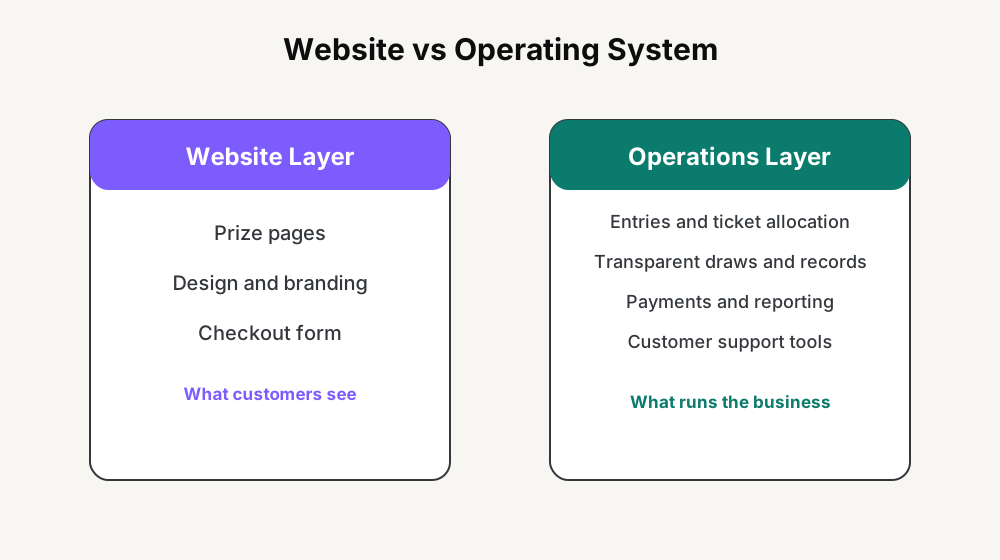
A platform is not just a website. It is the operating system for the business.
The right competition website platform should reduce operational friction, support transparency, help teams work faster and make it easier to run a trusted competition business.
The wrong platform can create hidden costs through manual work, plugin problems, developer dependency, poor reporting and weak customer workflows.
When choosing a platform, operators should assess:
Competition creation
Entry management
Ticket allocation
Payment visibility
Customer support tools
Draw transparency
Free entry handling
Reporting
Marketing integrations
Security and reliability
Ease of use
Developer dependency
It is worth reading a direct comparison of WordPress versus dedicated competition platforms before you commit to either route.
A platform should fit the way competition businesses actually work.
That means it should understand prizes, entries, draw dates, customers, winners, payments and support as core objects, not as awkward workarounds.
If the platform treats a competition business like a generic ecommerce store, the operator may end up filling the gaps manually.
Trust is not created by design alone.
Operators need systems that support accurate records, clear entry handling, reliable draw processes and customer-facing transparency.
The mechanics of publicly verifiable draws are a good example of transparency that customers can check for themselves.
A good platform should make it easier to market competitions clearly.
That includes fast prize page creation, clean tracking setup, clear customer journeys, email capture and the ability to support paid social growth without constant technical friction. If you plan to advertise on Meta, understand what Meta RMG approval for competition websites involves early.
Most operators underestimate the cost of platform friction.
A workaround that takes ten minutes once is not a problem. A workaround that happens every day across support, draws, entries and reporting becomes a tax on growth.
The best platform is the one that gives operators more time for prizes, customers, content and community.
That is the standard BaseComp is aiming for.
Does it support the competition model properly?
Can non-technical staff use it?
Does it reduce manual work?
Does it support clear records?
Does it support transparent draw processes?
Does it help with customer support?
Does it work with your marketing stack?
Does it reduce developer dependency?
Can it scale with traffic?
Can you test it before committing?
Custom software can be powerful, but it is expensive and creates maintenance responsibility. Many operators are better served by a dedicated platform.
Not if it creates operational cost elsewhere. Support time, developer time and missed growth can cost more than platform fees.
Create a competition, review the customer journey, check reporting, understand draw records and test support workflows.
See how BaseComp compares
Create a free BaseComp account and compare the experience against your current platform or build plan. No card required.
Get the latest tips, product updates, and industry news delivered to your inbox. No spam, unsubscribe any time.