
A practical guide to the Prize Competition Council, the Voluntary Code register and how monitoring works for UK prize competition operators.
The UK prize competition sector is becoming more organised. For operators, that means trust, standards and monitoring are becoming more important.
One of the key developments is the relationship between the Voluntary Code of Good Practice, the Voluntary Code register, DCMS oversight and the Prize Competition Council. This article explains the practical hierarchy operators should understand.
Not legal advice
This article is for general information only and does not constitute legal advice. Operators should verify the latest PCC, DCMS and Voluntary Code requirements before relying on this for operational decisions.
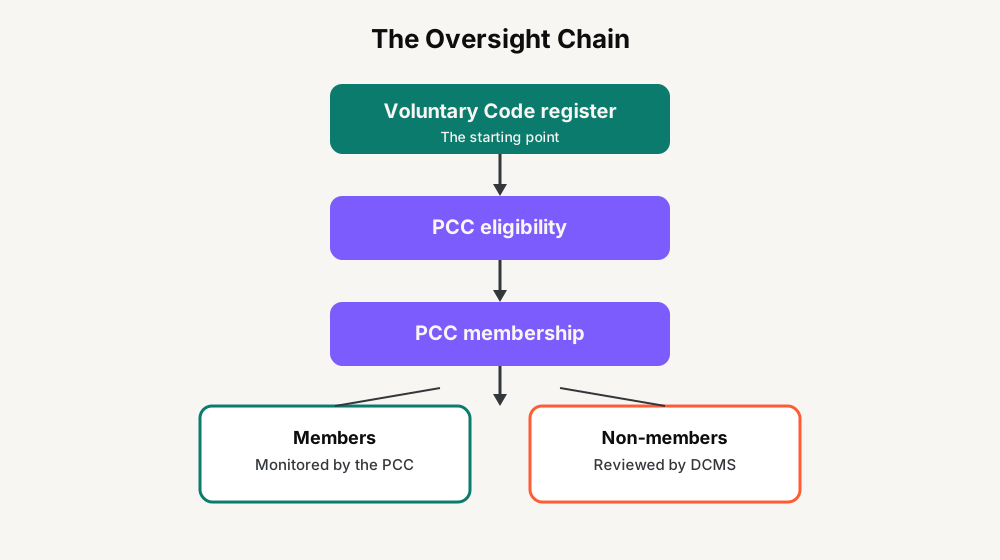
The Voluntary Code register is the starting point.
Being on the Voluntary Code register is the first condition of Prize Competition Council membership.
If an operator is not registered or does not meet those requirements, it is not allowed to be a PCC member.
The PCC takes responsibility for monitoring its members.
Operators that are not PCC members will be reviewed and monitored by DCMS.
The Prize Competition Council, often shortened to PCC, is intended to act as an industry body for prize competition operators that meet the required standards.
For operators, the important point is not just that the PCC exists. It is how PCC membership connects to the Voluntary Code framework. The PCC should be understood as part of a wider standards and monitoring structure, not as a replacement for legal obligations or responsible operation.
The practical structure can be explained like this:
Voluntary Code register
PCC eligibility
PCC membership
PCC member monitoring
DCMS review and monitoring for non-members
This matters because operators should not treat PCC membership as a simple badge. It depends on meeting the underlying requirements first.
Being on the Voluntary Code register is the first condition of PCC membership. That means an operator cannot treat PCC membership as separate from the Voluntary Code framework. If an operator is not registered or does not meet the requirements, it is not an allowed PCC member.
For serious operators, this creates a clear practical question: can we evidence that we meet the standards expected of registered operators?
That question is bigger than website wording. It affects customer protection, free entry routes, complaints handling, draw transparency, marketing standards and operational records. You can read more in our guide to the Voluntary Code of Good Practice.
The PCC takes responsibility for monitoring all of its members. That does not mean operators can stop thinking about compliance, trust or customer protection. It means members should expect their standards, processes and ongoing operation to matter.
Areas likely to be relevant include:
Clear customer information
Free entry route handling
Responsible operation
Marketing standards
Complaints process
Draw transparency
Winner communication
Customer protection
Operational records
Operators should assume that what they say publicly needs to match what they actually do operationally.
Operators that are not PCC members will be reviewed and monitored by DCMS. That means non-members are not outside the monitoring framework. They are simply monitored through a different route.
This is important for operators that think avoiding membership avoids scrutiny. It does not. The better question is whether the business is operating in a way that can withstand review from customers, payment providers, advertising platforms, industry bodies and DCMS.
PCC membership, Voluntary Code registration and legal compliance are related, but they are not identical. Operators should understand the difference between:
Legal obligations
Voluntary standards
Industry membership
Monitoring
Customer-facing trust signals
Marketing claims
A badge does not automatically make a business legally compliant. Equally, the absence of a badge does not remove the need to operate responsibly. Operators remain responsible for how their competitions are structured, promoted and delivered.
Standards are not just a compliance issue. They are commercial.
Payment providers, banks, advertising platforms, customers, suppliers and partners are all likely to care more about trust and governance as the sector matures. Operators that can demonstrate strong standards may be better placed to build long-term confidence. Operators that cannot explain their processes may face more friction.
The direction of travel is clear. The UK prize competition sector is becoming more professional, more visible and more accountable. That is a good thing for serious operators.
The best operators should not see the Voluntary Code, PCC membership or DCMS monitoring as a burden. They should see them as signals that the industry is maturing. The opportunity is to build competition businesses that are easier to trust because their standards are built into the way they operate.
Technology has a role to play here. Clear records, consistent workflows, transparent draws, responsible play controls and better customer communication all make it easier for operators to evidence good practice.
Confirm current Voluntary Code register position
Review PCC membership criteria
Check whether the business meets required standards
Review free entry route visibility
Review responsible play controls
Review complaints process
Review draw transparency
Review winner communication
Review marketing claims
Keep operational records clear
Avoid unsupported membership claims
Verify all public badge and membership wording
No. Being on the Voluntary Code register is the first condition of PCC membership.
No. If an operator is not registered or does not meet the requirements, it is not an allowed PCC member.
The PCC takes responsibility for monitoring all of its members.
Operators that are not PCC members will be reviewed and monitored by DCMS.
No. Operators remain responsible for their own legal obligations, structure, terms and operation.
Only if accurate, current and supportable. Operators should not use badges, wording or claims unless they can evidence them.
Build standards into the way you operate
Create a free BaseComp account and explore how better platform structure can support transparent, responsible operation. No card required.
Get the latest tips, product updates, and industry news delivered to your inbox. No spam, unsubscribe any time.